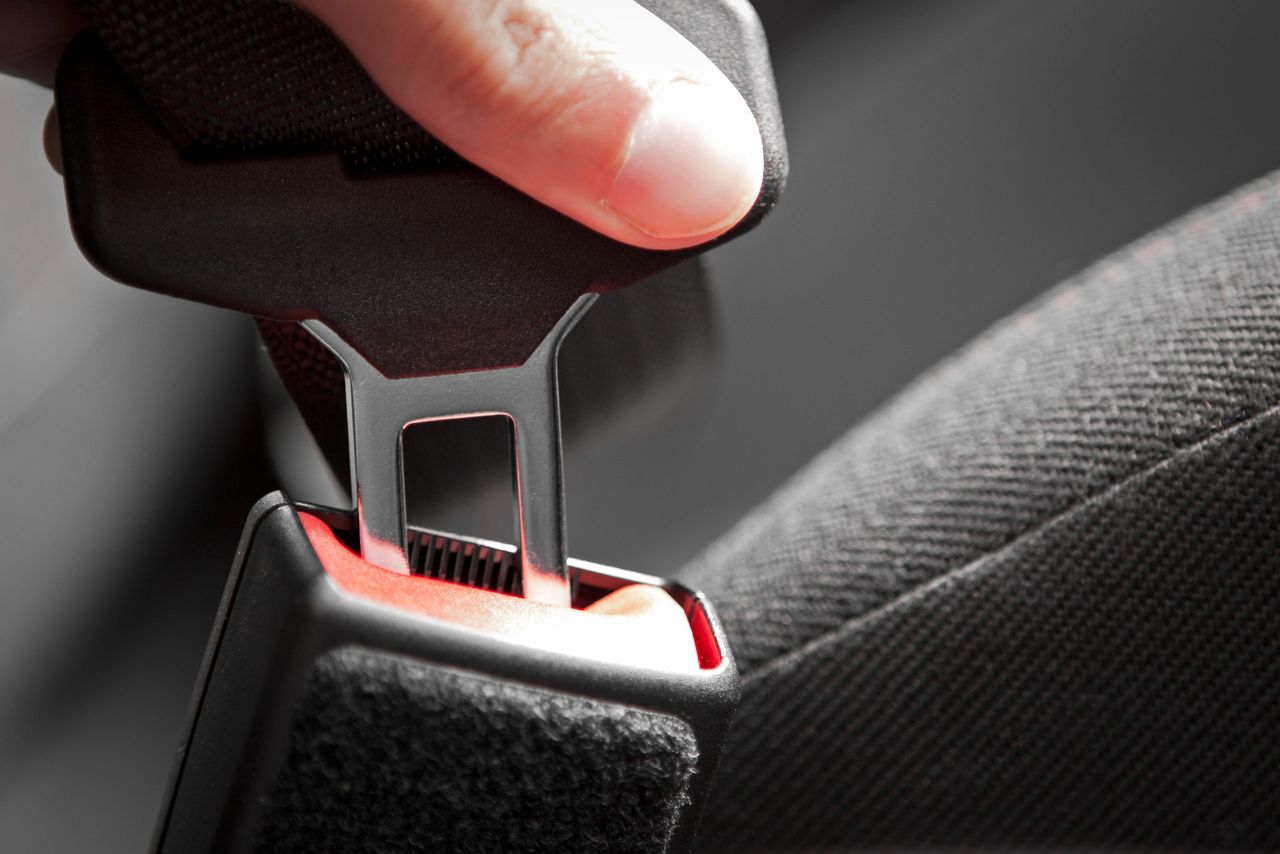
A safety belt assists with forestalling injury in case of a fender bender by diminishing the speed of a body as it’s anything but an unexpected abatement in speed. Because of the body’s idleness, which is it’s anything but ‘a shift in speed or bearing of movement’, a traveler in a vehicle will need to keep voyaging advances once the vehicle has arrived at an abrupt stop. On the off chance that the vehicle is going at 50mph and collides with a block facade, immediately decreasing its speed to nothing, the traveler will keep moving advances at 50mph except if there is something before them to make a ‘halting power. This is on the grounds that the speeds of the vehicle and traveler are free.
A safety belt spreads the halting power expected to decelerate the traveler across their body. This keeps the body from hitting the windshield or directing a segment of a vehicle at rapid, which could without much of a stretch outcome in injury or demise.
The belt is intended to apply a large portion of the halting power needed to the pelvis and rib confine, the two of which are generally hearty. Since stress is conversely corresponding to the space at which power is being applied, we can reason that if the halting power is spread across a bigger region, the less pressure the body will insight in case of an accident.
Because of the way that an unexpected halting power could add to a traveler’s physical issue, the material of which a safety belt is built from is intended to consider a limited quantity of development as the body attempts to move advances. Stretching the time taken for the body to halt assists with diminishing the effect that the body encounters.
Commonly, a safety belt will incorporate a ‘retractor component that makes a spring inside the retractor apply a rotational power to the spool when it is being pulled. This implies that the belt fixes once it turns out to be free to diminish the measure of ‘slack’ in the material, assisting with tying down the traveler to their seat.
Present-day safety belt systems likewise incorporate pretensions, which pull the belt inwards once the vehicle arrives at an unexpected stop. The pretensioner is joined to an office of burnable gas and a focal processor, which can recognize a fast lessening in the vehicle’s speed. Whenever this is distinguished, an electrical flow is sent across two cathodes, which makes the gas be lighted. This makes the pressure that pushes on a cylinder in the chamber, causing the safety belt spool to rapidly turn, ending up any free material.
Some facts about Seat belts:
*There are six different types of seat belts, two-point, three-point, four-point, five-point, and six-point seat belts.
*English engineer George Cayley created the two-point safety belt for his lightweight planes during the nineteenth century.
*Volvo, along with Swedish mechanical engineer Nils Bohlin, invented the three-point seat belt in the 1950s.