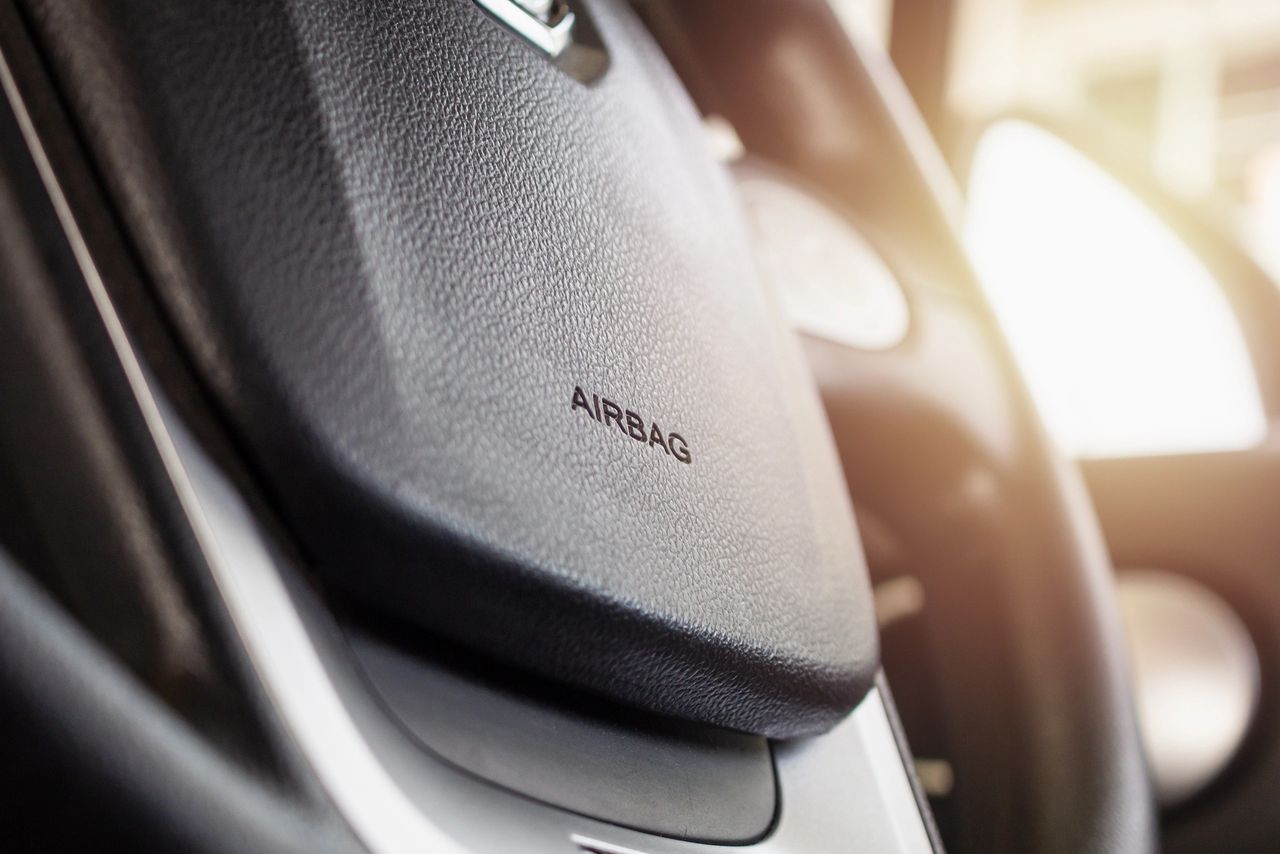
An airbag is a vehicle occupant-restraint system using a bag designed to inflate extremely quickly, then quickly deflate during a collision. It consists of the airbag cushion, a flexible fabric bag, an inflation module, and an impact sensor. The purpose of the airbag is to provide a vehicle occupant with soft cushioning and restraint during a collision. It can reduce injuries between the flailing occupant and the interior of the vehicle.
The airbag provides an energy-absorbing surface between the vehicle’s occupants and a steering wheel, instrument panel, body pillar, headliner, and windshield. Modern vehicles may contain up to 10 airbag modules in various configurations, including the driver, passenger, side-curtain, seat-mounted, door-mounted, B and C-pillar mounted side-impact, knee bolster, inflatable seat belt, and pedestrian airbag modules.
During a crash, the vehicle’s crash sensors provide crucial information to the airbag electronic controller unit (ECU), including collision type, angle, and severity of impact. Using this information, the airbag ECU’s crash algorithm determines if the crash event meets the criteria for deployment and triggers various firing circuits to deploy one or more airbag modules within the vehicle. Working as a supplemental restraint system to the vehicle’s seat-belt systems, airbag module deployments are triggered through a pyrotechnic process that is designed to be used once. Newer side-impact airbag modules consist of compressed-air cylinders that are triggered in the event of a side-on vehicle impact.
The first commercial designs were introduced in passenger automobiles during the 1970s, with limited success, and actually caused some fatalities. Broad commercial adoption of airbags occurred in many markets during the late 1980s and early 1990s with a driver airbag, and a front-passenger airbag, as well, on some cars, and many modern vehicles now include six or more units.
The number of embedded airbags is growing rapidly. Just recently, the car with two airbags was considered a luxury and now having a dozen would not surprise an average driver. All bags are working on one principle but there are many differences. For example, the driver cushions size ranges between 60 and 80 liters, while the passenger needs a much bigger 130-160 liter volume. Side impacts are often no less dangerous than frontal. Naturally, the car manufacturers could not leave it unnoticed over the past 10 years and many cars got their side-bags. They are much smaller than the frontal airbags, the volume ranges from 15 to 25 liters. There are also different forms. Along with the conventional “mushroom type”, there are extended “long rollers” in the shoulder area and “inflatable shutters”, reliably protecting the head of the driver and rear passengers. You can more and more often find a pillow under the front panel or on the floor as the driver’s and passenger’s legs should also be protected. And the last inventions are the cushions to protect pedestrians. Two rollers fired from the radiator grills and a slit between the hood and windshield, designed to minimize the damage of adult pedestrians and children. Airbags for motorcycles and scooters are already installed by the customer’s request.
Interesting facts about airbags:
* Passenger airbag is usually twice as big as the drivers due to the greater distance from the dashboard.
* To make an airbag fill up the full volume it needs 25-50 m/sec (for a comparison an eye blink takes about 100 m/sec)
* Airbag opening speed reaches 320 km/h
* “Renault” car maker installs a small airbag in the frontal part of the driver’s seat to prevent diving under the seat belt.